M. J. Rymsza-Pawloska is a Director at American University for the Public History graduate program. Her book History Comes Alive: Public History and Popular Culture in the 1970s, discusses how during the 1960s and 1970s American TV became saturated with historical shows and mini-series about American history. This is contrast to earlier generations of Americans who seemed more focused on the future. “Americans had been looking forward…not only political and technological priorities like space exploration but also popular culture.” (Rymsza-Pawloska, 2). This shift in focusing on the future to focusing on the past was dubbed the “nostalgia culture” (Rymsza-Pawloska, 2).
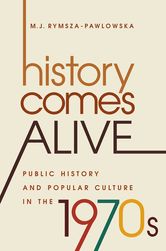
Rymsza-Pawloska claims that reflecting on the past during times of extreme growth is not a new concept, but instead a habit that people come to over and over again. These times of reminiscing have become known as revivals and Americans have gone through several of them throughout history. Rymsza-Pawloska references the colonial revival of the 1920s where art and antiques from the 18th century were replicated. She does this to point out a key difference between earlier revival periods and the 1970s nostalgia culture.
The main difference between the two is that earlier revivals focused heavily on replicas, memorials, monuments, and reenactments. However, the 1970s nostalgia culture was much more interactive. The focus was not on reenactment but understanding. “Instead, they were relating to and identifying with particular expressions of history in novel ways, looking to place themselves directly into the past, to know and feel the experiences of historical individuals as we as to see them.” (Rymsza-Pawloska, 4). This type of historical interaction is what we still use today. In her book, History Comes Alive: Public History and Popular Culture in the 1970s, Rymsza-Pawloska labels this interaction “historical consciousness-not only what we think of the past, but how we think of it and for what purpose” (Rymsza-Pawloska, 11). She explores the different ways we express historical consciousness in each chapter.
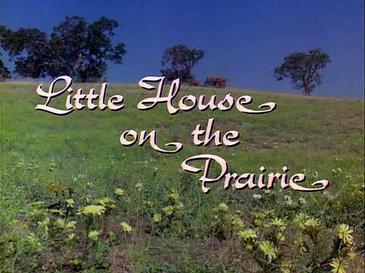
History on television took off in the 1960s and 1970s. With shows like the Little House on the Prairieand miniseries like Roots it is clear that Americans had a fascination with the past. Rymsza-Pawloska also points out that, “While television has long been considered an index of American culture, it is a particularly apt site for the consideration of the transformation of popular historical consciousness” (Rymsza-Pawloska, 38). Additionally, much like World Fairs inspired interest in history, the 1976 Bicentennial sparked a deeper interest in history. Specifically “to look at the history of history itself” (Rymsza-Pawloska, 65). The Bicentennial Minutes were a one-minute snippet of what happened 200 years prior.
Additionally, learning is not the only goal or success of an engaging interactive experience. With history being so prevalent on television preservation became more relevant. This sparked the “preservation is people” slogan meaning “the democratization of building preservation, but, in other ways, preservation literally was people, as oral history initiatives that documented the lives of everyday people expanded” (Rymsza-Pawloska, 82). The results were a spike in the preservation of historic locations as well as, giving people power to preserve history. Preservation, activism, and the contribution to historical knowledge are all prevalent at this time. This allows the audience to identify with the past in away that can’t compare to reading a book. It allows the viewer to be a participant and owner of history.
Museums would also undergo a change during this time. It became increasingly more important to offer an interactive experiences that would immerse an audience. Rymsza-Pawlowska references “affective engagements or affinities with the past”( Rymsza-Pawloska, 117) which is very similar to Landsberg’s Engaging the Past. In which the viewer of history is more of an active participant. With reenactments and other activities used to unite the audience with history in a museum setting.
Rymsza-Pawloska is documenting the cultural changes that lead to a shift in the way people interact with history. No longer are we just passively remembering the past through replicas and museums. Instead, we are engaging the past in away that is much more interactive. We are taking responsibility for preserving the past and becoming more mindful of how our personal interpretations shape our understanding.
Works Cited:
M. J. Rymsza-Pawlowska. (2017). History Comes Alive : Public History and Popular Culture in the 1970s. The University of North Carolina Press.
 Archives Of My Mind
2 responses to “History Comes Alive”
I love the clips you added. It makes my verbal diatribe boring. I agree with your comment about nostalgia being a trend. As a culture, we sure do like to bring things back from a bygone era. It does seem that according to the book reenactments flourish at this time. Some events may have died out but I think Civil War reenactments are still going strong. I often wonder about concepts such as the democratization of preservation. What is being preserved and who for? Is the whole truth being preserved or only a partial truth? I also agree with your comment comparing this book with the previous book. Interacting with history is not passive and certainly makes history come alive.
LikeLiked by 1 person
I agree with your point about reenactments having cycles. I know ren fair is more larping than a reenactment, but I wonder what role it plays in this cycle? Do we see other reenactments go the route of fantasy the way the renaissance has? I can’t imagine Civil War reenactments meeting that same fate because it is a specific war. However, I wonder about that time period?
LikeLike