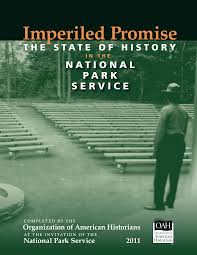
In the book Imperiled Promise: The State of History in the National Park Service the authors (Anne Mitchell Whisnant, Marla R. Miller, Gary B. Nash, and David Thelen) argue that National Park Service workers have a major role to play in historical preservation. They point out that there is more than just picturesque landscapes and endangered wildlife at stake. They have the job of preserving cultural sites as well. To do this they need to juggle the challenging task of staying relevant while respecting the original culture they now represent through the park.
I really enjoyed the section on “Interpretation vs History”. The authors claim that, “…the context of historical interpretation has fallen out of step, in many cases, with the best professional, scholarly practices in history” (pg 27). That is a bold claim, but it is one that the authors follow up with “12 basic approaches to historical research and interpretation” (pg 29). All 12 approaches are wonderful, but two stood out as being relevant to my current research.
The first being that we should “attend to the roles of memory and memorialization at historical sites”. I am working on a project the explores the migration of the dead as St. Louis expanded into the city we know today. As the city grew and cemeteries had to make way for the living, headstones would be torn down and burials forgotten. At the time people did not think they were dismantling a would-be historic site. They assumed they were making way for a new street, a new apartment build, or a school. As a result, a lot of history was lost. However, my real concern and question comes from the current response to these forgotten gravesites when they are re-discovered by construction crews.
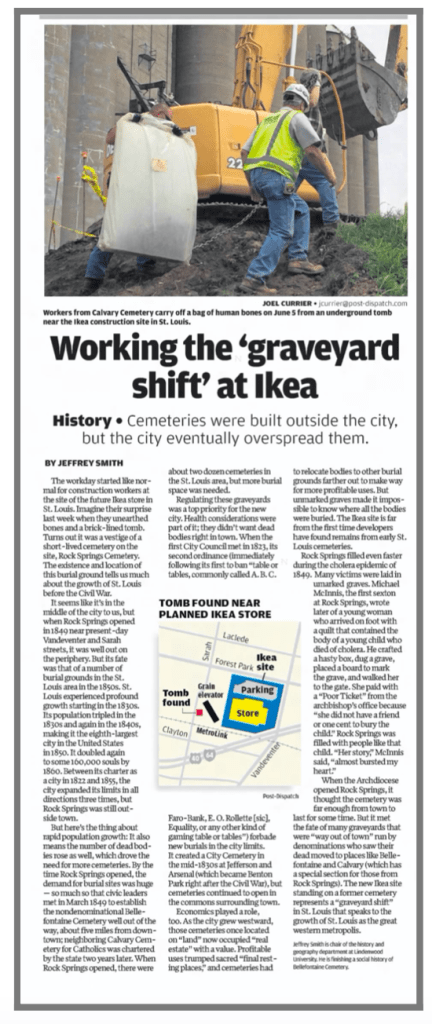
St. Louis City is still changing in many ways. In 2014 when Ikea was built construction crews dug up the remains of someone lost when the original graveyard was moved to Calvary. It was made very clear that no excavation would be done to search for any more potential graves, because that would halt progress. Consequently, Ikea might sit on top of more unmarked, forgotten graves. Historians, preservationist, and archaeologist tried to push back and argue the importance of searching for these lost graves. But what can they do? What can we do when the greater public seems oblivious to the memory or memorialization at a historic site or in the case of Ikea, when big business sees the very act of memorialization as a threat to progress?
Which brings me the 2nd point that stood out to me, “better connect with the rest of the history profession and embrace interdisciplinary interaction”. As an Anthropology major in a Museum Studies Program hosted by the History Department that point, in particular, got me asking a lot of questions. How can we be better at working with other disciplines to preserve our history? Afterall it is all of our history and it doesn’t only belong to historians. What could we do not just as historians, but as students? How can we use the resources available to us at our university to make those connections now? Are there any gaps in our current program that could be filled?
Overall, Imperiled Promise provides a lot of good talking points. However, those talking points need to branch beyond historians, and national park services. We need to bring them to our communities and get their feedback. We have to stop championing ourselves as the force preserving our history and recognize that we are a part of an entire network that owns history, is actively making history and will ultimately influence how history is remembered.
 Archives Of My Mind
2 responses to “Imperiled Promise”
I appreciated how you brought an example from St. Louis into the mix to help get your point across. I remember reading about the controversy with where Ikea was built and the potential for other graves to be discovered. It makes me wonder, if right across the street from Ikea, where the new City Foundry is be is being established, if there could be potential graves there. That is a historic site away. It was the site of the Century Electric company and City Foundry claims to be honoring that history. I will be interested to see how and in what capacity.
LikeLiked by 1 person
progress is such a nasty idea. I would bet there are more graves throughout the city that we do not know about. I mean, the city was built on mounds that were just dumped into the river. How much history was lost then? How much is lost now? I know one thing certain, its not democracy that most people fight for, it is free enterprise, capitalism, and the almighty dollar. Threatening money is really what drives agendas in this nation. I am afraid many historic sites will continue to be neglected because of this very fact. Poor Ikea man, not poor Ikea.
LikeLike