In Mapping Decline: St. Louis and the Fate of the American City (Politics and Culture in Modern America)Gordon argues that St. Louis, Missouri is another example of an abandoned, deindustrialized, and segregated American city. Gordon claims that the restrictions on real estate, segregation in neighborhoods, white flight to suburbia, and industries leaving the city have all lead to the decline of St. Louis.
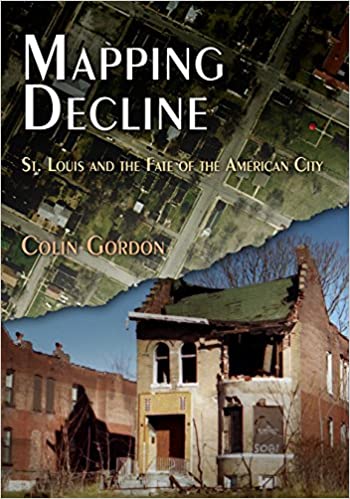
Gordon’s argument is compelling and I really enjoyed his use of maps to prove his point. His book reminded me of another book, The Origins of the Urban Crisis: Race and Inequality in Postwar Detroit by Thomas Sugrue. Both authors maintain the role of deindustrialization and white flight in the decline of American Cities. Sugrue goes as far as to call cities “reservations for the poor”. This is a sentiment that I think Gordon would agree with even if he doesn’t come out and say it as plainly as Sugrue.

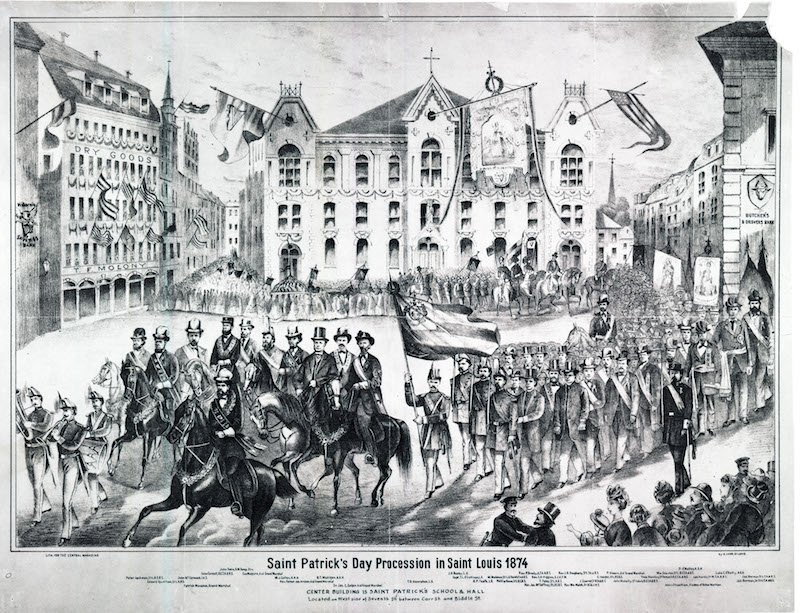
One minor critique I have of Gordon’s book is that I think white flight starts a lot earlier than we realize. Even earlier than when he first discusses it as taking place in the 1940. White flight is often talked about as a post WWII occurrence. However, in St. Louis (and other cities) we can see white flight occur much earlier. The Kerry Patch area of St. Louis is a perfect example. It was once an Irish dominated cluster of city blocks ranging from Biddle St (South) to Mullanphy St (North) and 20th St (West) to 9th St (East). By the 1910s the Irish population had almost moved out entirely. By 1930 Kerry Patch was no longer an Irish neighborhood. Additionally, in 1920 Washington Park Cemetery is established as an African American cemetery.
Overall, I think that Gordon’s book is incredibly insightful. It shows that he cares about the well-being of St. Louis and those who live there.
Below is a link to a list of several landmarks demolished in St. Louis. I can’t help but wonder if some of these landmarks were destroyed not because of their condition but because of where they are located in the city. If they were still in “white” neighborhoods would we still be able to visit them today?
 Archives Of My Mind
3 responses to “Mapping Decline”
I think your use of Sugrue’s text was interesting in relating it to Gordon’s arguments. ‘Reservations for the poor’ paints a picture that i think is relevant to what Gordon was discussing and only helps enforce what the GIS mapping made plain for us.
LikeLike
That poor house. I would like to say oh that poor city but St. Louis did it to itself. I also like you use of an outside source corroborate your ideas. I agree with you assessment of white flight probably starting earlier than presented. I think it has gone in multiple waves. The waves seem to continue over the course of one hundred years. Oh this town.
LikeLike
YES! his work is very much in the spirit of Tom Sugue’s. glad you picked up on that!
LikeLike